You trained to be a counsellor. But nobody said you’d spend quite so much time wondering what on earth you’re supposed to be doing with your website.
Or your directory profile. Or your blog. Or social media. Or SEO. Or any of the other things that suddenly become your problem when you’re trying to make a private practice work.
And when ‘I need more clients’ starts taking up more and more space in your head, it’s surprisingly easy to lose sight of something much bigger.
What did you actually want all this for?
More...
Have you ever had a job that you absolutely loved? I mean, really loved. The sort of job where Sunday evening didn’t come with that sinking feeling because you were actually looking forward to Monday morning?
I used to hear people talking about how much they loved their jobs, how they couldn’t wait to get to work and how they were ‘living the dream’. And the truth is, I didn’t believe them. I just couldn’t imagine anybody enjoying a job that much.
For me, work was something you did because you needed to earn money so you could get on with the rest of your life. I’d spent years in jobs where yes, the people were great, but the work itself bored me senseless. I watched the clock, I didn’t particularly enjoy what I was doing and I certainly didn’t understand these strange people who claimed to look forward to Mondays.
And then I became a counsellor and realised I’d been completely wrong.
I loved it.
I found people fascinating, I loved seeing somebody make a connection or begin to understand themselves differently, and the work felt worthwhile in a way I’d never experienced before. It had purpose, I felt as though what I did had value, and it was job satisfaction with bells on.
Having my own private practice added something else too. People found me, chose to work with me and paid me for something they valued, and I was building something of my own. I had freedom and choice over my working life in a way I’d never had before.
Of course, it wasn’t perfect. There were cancellations, money worries and accounts to deal with, and anything involving maths still makes me want to cry. But living the dream doesn’t mean loving every single part of your working life; for me, it meant creating something where the bits that mattered made the rubbish bits worth dealing with.
Remember how much you wanted this?
Can you remember what made you want to become a counsellor?
Because most people don’t casually look around for a new job and think, ‘Counselling. That’ll do.’ Something usually draws you towards it. Maybe you’ve always been fascinated by people, you were traditionally the person everybody came to talk to, your own experience of counselling had a big impact on you, or you wanted to do something that felt meaningful and made a difference.
And then, once you’d decided that was what you wanted, you had to actually become one.
There was the training, the reading, the assignments and all the personal development that comes alongside it. There was the cost, finding a placement, working for free once you’d found one, paying for supervision and somehow fitting everything around the rest of your life.
Then there were those first clients. I can still remember how scared and excited I was after seeing my first one, with a strange mixture of ‘Oh my God, I’ve just seen my first client!’ and ‘Oh my God, that was rubbish, I should have said this and I should have said that.’
But eventually you got there. After all that work, you had the piece of paper that said you were a qualified counsellor.
You really wanted this.
So I’d like you to remember that version of yourself for a minute. What were you excited about when you finally got there, and what did you imagine this new working life was going to give you?
What did you want counselling to make possible?
For me, loving the actual work was only part of it. A huge part of what I wanted from my working life was freedom and choice, and that became particularly important because of what was happening in the rest of my life at the time.
When I started my private practice, my children were still young and I’d recently separated. We’d moved house, they were adjusting to the break-up of our family and I knew they needed me to be around. I also wanted to be able to go to school sports days and all those other things that can be very difficult when somebody else decides when you’re allowed to work.
Having my own private practice allowed me to do that.
So my dream wasn’t simply to become a counsellor, have a certain number of clients or earn a certain amount of money. It was also about what doing this work in this way made possible in the rest of my life.
And yours might be completely different.
Perhaps you wanted work that interested you and felt meaningful. Maybe you wanted more control over your time, to earn a decent living doing something you valued, to fit work around your health or your family, or simply to stop spending your Sunday evenings dreading Monday morning.
And perhaps you never dreamed about running a private practice at all. For many counsellors, private practice isn’t something they always longed to have; it’s simply become the way they can do the work they trained to do.
Whatever brought you here, though, I think it’s worth asking: what do you want this working life to make possible for you?
Then there’s the small matter of running a business
Unfortunately, qualifying as a counsellor isn’t the end of the story. In many ways, it’s the beginning, because if you go into private practice you soon discover there’s insurance, GDPR, policies, accounts, websites, directories, marketing and all sorts of other things you probably didn’t lie awake dreaming about during your training.
Oh. More admin. Great.
I’ve talked about this before in episode 209, ‘Marketing Might Not Be Your Favourite Bit—But It Is the Important Bit’, because however much you love counselling, there are other jobs that come with running a private practice. Marketing is one of them, and it matters because people need to be able to find you. If they can’t find you, they can’t choose to work with you, and ultimately you don’t have a viable business.
But there’s another side to that.
All those things that need doing can gradually start taking up more and more of your attention. Instead of thinking about the working life you wanted to create, you’re wondering why you aren’t getting enough enquiries, what’s wrong with your website, whether you should be blogging, whether you ought to be doing more on social media, if you need to sort out your SEO and what on earth you’re supposed to be focusing on first.
And somewhere along the way, everything you wanted from this working life can shrink down to one thing: ‘I just need more clients.’
‘I need more clients’ isn’t the dream
Now, you might genuinely need more clients. I’m certainly not going to sit here and tell you that client numbers don’t matter when you’ve got bills to pay and you need your practice to be financially viable.
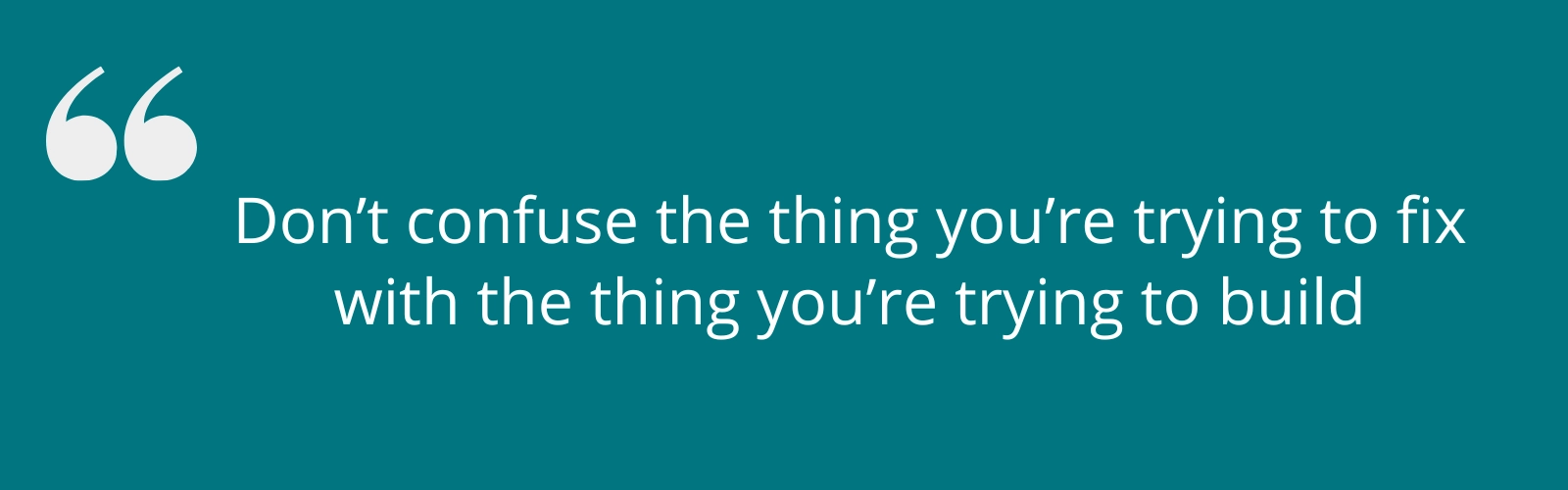
‘Don’t confuse the thing you’re trying to fix with the thing you’re trying to build.’
‘I need more clients’ might be a very real problem that you need to sort out, but it isn’t the whole reason you went through everything involved in becoming a counsellor.
And when you’re focused on what isn’t working, it’s surprisingly easy to stop noticing what is.
Let’s say you’d like 12 clients a week and at the moment you’ve got seven. It’s very easy for those five empty spaces to become the only thing you see, because they represent what you haven’t achieved yet and the income you’re not earning.
But what about the seven?
Seven people found you and decided that you were the person they wanted to talk to. They’re trusting you with parts of their lives that they might not talk about anywhere else, and you’re doing the work you once spent years training to be allowed to do.
You built that. You.
That doesn’t mean you have to settle for seven when you want 12, and I’m not suggesting you stick a grateful smile on your face and stop wanting things to improve. You can absolutely think, ‘I want this to work better’ while also taking a moment to think, ‘Bloody hell, look what I’ve already created.’
Maybe some of what you once hoped for is already happening, but you’ve become so used to it that you’ve stopped noticing.
So what do you want now?
There isn’t one version of a successful private practice, and this is something I think we forget far too easily.
Maybe you want 20 clients a week and a full private practice. Great. But maybe five clients alongside another job you enjoy would give you exactly the working life you want.
Perhaps you’d like counselling to become one part of what you do alongside writing, workshops, training or supervision. Maybe you want to work with a particular group of people or develop an area of work you find fascinating. Perhaps freedom matters enormously to you, or perhaps right now income is the priority because you need your practice to earn more.
And what you want now might not be what you wanted when you first started training. Life changes, we change, and the dream is allowed to change with us.
The point isn’t to create the private practice you think you’re supposed to want. It’s to work out what you want your working life as a counsellor to look like now.
So if you could put aside all the ‘shoulds’ for a moment, what would that actually look like? How much would you work and when would you work? What kind of work would you be doing? What would you like to earn, and what would you like your week to feel like?
What would need to be happening for you to sit there one day and think, ‘Do you know what? This is a pretty good life.’
And what will get you closer to it?
Of course, working out what you want doesn’t magically make it happen. If only.
There are going to be things you need to do to move towards it, and some of them might not feel particularly comfortable. You might need to change something that isn’t working, learn something new, make a decision you’ve been avoiding, put yourself out there a little more or try something without knowing whether it’s going to work.
When something feels difficult or unfamiliar, it can be tempting to see that as evidence that perhaps you’re not cut out for running a business. But I’d encourage you to remember everything you had to learn to become a counsellor in the first place.
There was a time when you didn’t know how to sit in front of a client and trust yourself to know what to do. You didn’t know how placements worked or how to put everything you were learning into practice, but you learned as you went along.
Growing a private practice involves learning things too, and some of them won’t be things you particularly want to learn. That doesn’t mean you need to become a marketing expert, a blogging expert, a website expert and an expert in every other job that comes with running a business. But it does mean accepting that creating the working life you want will probably involve doing some things that feel new or difficult along the way.
And this is where focus starts to become really important.
So what deserves your attention now?
Because once you know what you’re actually trying to create, you can stop asking the enormous, impossible question, ‘What should I be doing?’ and ask something much more useful instead:
‘What will move me closer to what I actually want?’
The answer will be different for everybody. Someone who wants five regular clients alongside another job may need to focus on something completely different from someone who wants a full private practice, while someone whose diary is already full but who wants more freedom has a different problem again.
There isn’t one universal next thing every counsellor needs to do. It depends on where you are now, what’s working, what isn’t, what you want to create and what’s getting in the way.
And that’s where it can get really difficult.
Because you might know that you want more clients, more income, more freedom or simply to feel as though your practice is actually moving forward, but that doesn’t necessarily mean you know what to do next.
There are so many things you could be doing. You could work on your website, rewrite your directory profile, start blogging, look at your SEO, post more on social media, sort out your Google Business Profile… and before long, everything starts to feel equally important.
So you do a bit of this, a bit of that, start something new, go back to something else and still have that nagging feeling that you’re not really getting anywhere.
I’ve spent years working with counsellors who find themselves in exactly this position. They’re not short of things they could do; if anything, they’ve got too many. The difficult bit is working out which things actually matter for their practice, given where they are now and what they want to achieve.
That’s the problem I created Find Your Focus to solve.
Find Your Focus is a 90-minute 1:1 session where we take a proper look at your private practice: where you are now, what you want, what’s already working, what isn’t and what’s actually getting in the way.
Then, rather than adding more things to your list, we work out what deserves your attention now.
You’ll come away knowing what to focus on next and why, with a much clearer sense of where to put your time and energy instead of constantly wondering whether you should be doing something else.
And because I know what it’s like to have a really useful conversation and then promptly forget half of it, you’ll also get the recording, a summary and your own personalised focus document afterwards.
Find out more about Find Your Focus HERE
So perhaps it’s worth going back to the person you were when you first decided to become a counsellor and remembering how much you wanted this.
What were you hoping for?
And, perhaps more importantly, what are you hoping for now?
Because ‘I need more clients’ can very quickly become ‘I need to do everything’, and you don’t.
You need to know what matters for you, your practice and the working life you want to create.