
Have you noticed how, when you become experienced at something, you often stop noticing how much you've learned?
The ideas that once felt exciting become familiar. The concepts that changed the way you saw yourself and the world gradually become part of your everyday thinking. Over time, what was once a hard-won insight starts to feel like common sense.
It's easy to assume this is simply imposter syndrome. Sometimes that may be part of it. But I think there's something else going on too.
Because I think many counsellors are walking around with years of valuable knowledge, experience and insight that they've stopped recognising because it feels so natural to them now. The result is that they underestimate what they know, overlook the value they bring and sometimes dismiss the very ideas that could help clients, readers and potential referrals understand them better.
So if you've ever found yourself wondering whether you really have anything useful to say, or why it can be so difficult to recognise the value in your own experience, this might explain why.
And more importantly, it might help you see your own knowledge, experience and expertise a little differently.
What if the things you've stopped noticing are actually some of the most valuable things you know?
More...
The day I realised how much I'd learned
A few years ago, I signed up for some marketing training and found myself feeling disappointed.
That sounds harsher than I mean it to. The training itself was absolutely fine. The problem wasn't the training; the problem was that I'd gone into it expecting the feeling I used to get when I first started learning about marketing.
Back then, every podcast seemed to contain a new idea. Every book introduced a concept I'd never heard before. Every training course felt like opening a door into a room I didn't even know existed. There was always another strategy, another approach or another way of thinking about things that I wanted to understand.
It was exciting. At times it was slightly intimidating too, but mostly it felt like a world of possibilities had opened up in front of me.
This course felt different.
As the training went on, I kept finding myself thinking, 'I've heard that before.'
A little later, 'I know that already.'
And then, 'Actually, I'm already doing that.'
At first, I assumed this was a reflection of the training. It took me a while to realise it wasn't.
What I was actually noticing was how much I'd learned.
Without really paying attention, I'd spent years reading, listening, experimenting, making mistakes and figuring things out. The things that once felt complicated had gradually become familiar. The ideas that once felt exciting and new had become part of the way I thought.
And because they felt familiar, I'd stopped noticing them.
I wonder if you've ever had a similar experience.
Perhaps you've attended a workshop, listened to a podcast or read a book and realised that much of it wasn't new to you anymore. Not because you've reached the end of your learning journey - none of us ever do - but because the things that once felt new have gradually become part of who you are.
That's the thing about expertise. It rarely arrives with a fanfare.
You don't have a Neo from The Matrix moment where you open your eyes and say 'I know counselling.'

Instead, the things you once had to think hard about become things you do automatically. The concepts that once felt complicated become familiar. The ideas that once felt exciting become woven into your everyday thinking.
And because they become familiar, it's easy to stop noticing them altogether.
The ideas that changed us
I remember this from my counselling training too.
After I qualified, I trained further in Transactional Analysis and one of the things that had the biggest impact on me was the way Adrianne Leigh taught at the Byrne Institute in Nottingham. She used stories constantly. Not stories for the sake of it, but stories that suddenly made an idea click.
More than fifteen years later, I can still remember sitting there and having one lightbulb moment after another.
Things that I'd never understood before suddenly made sense. Patterns I'd noticed in myself started to have names. Relationships looked different. People looked different. I looked different.
At the time, those ideas felt huge.
They weren't simply interesting theories that helped me pass a course. They genuinely changed the way I understood myself and the people around me. Some of them helped me make sense of experiences I'd struggled to understand for years.
If you've done counselling training yourself, you'll probably recognise that feeling.
Do you remember how much some of those ideas affected you when you first came across them? Do you remember leaving a training day with your head buzzing because something had suddenly clicked into place? Do you remember seeing your clients, your family or yourself through a completely different lens?
Those moments matter.
The trouble is that over time they become absorbed into who we are. What once felt astonishing gradually starts to feel obvious. What once felt profound becomes part of our everyday thinking.
Today, many of those same ideas feel completely natural to me. They've become part of the lens through which I see the world.
And that's exactly where the problem begins.
Familiarity disguises value
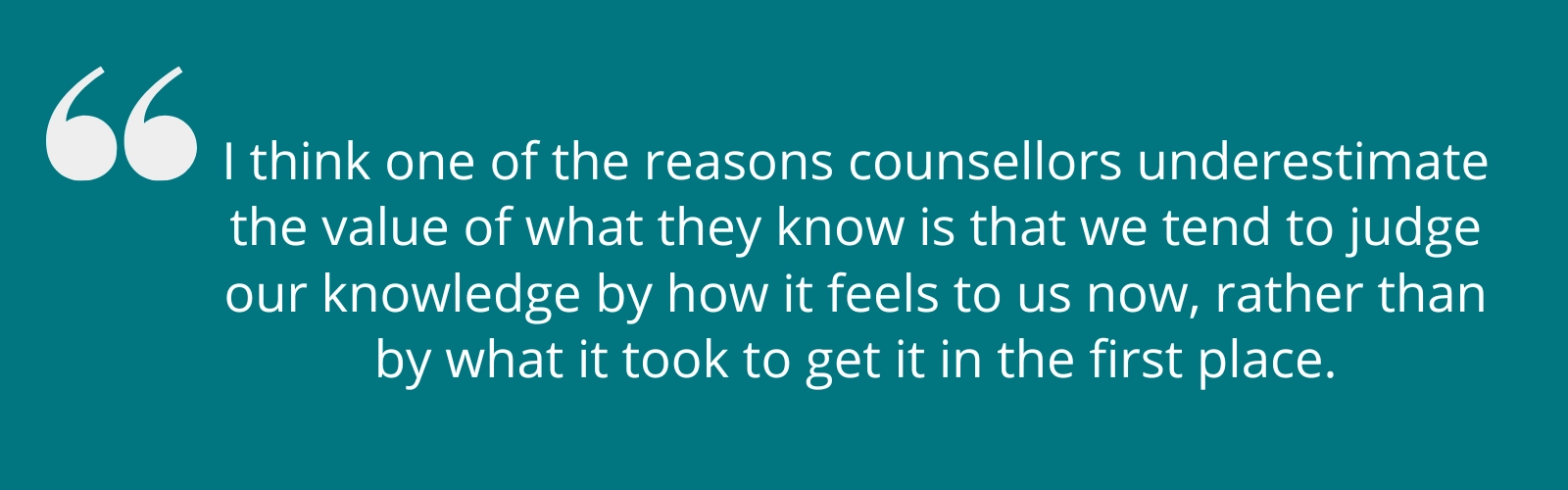
We stop seeing the years of training, reading, reflection, supervision and client work. We stop seeing the lightbulb moments, the difficult conversations and the gradual accumulation of experience. Instead, we only see the end result.
We see an idea that feels straightforward.
We see a concept that makes sense.
We see something we can explain in a few sentences.
And because it feels straightforward now, we assume it must always have been straightforward.
But those are two very different things.
Something can feel simple and still be incredibly valuable. In fact, some of the most useful ideas are simple. Not because they lack depth, but because they've been understood so thoroughly that they can be explained clearly.
That's very different from being basic.
The danger is that familiarity starts to disguise value.
The more familiar something becomes, the less remarkable it feels. The less remarkable it feels, the easier it is to assume everybody else already knows it too.
But that's rarely true.
What clients remember
I see evidence of this outside of work all the time.
Every now and then I'll be chatting to somebody socially and they'll mention that they've been to counselling. Usually they'll tell me how much it helped them and then they'll share something they learned along the way.
It might be a new understanding of boundaries. It might be recognising a pattern they'd been repeating for years. It might be the realisation that they're allowed to have needs too, or that they're not responsible for everybody else's feelings.
As they're talking, it's obvious how important that insight was to them. You can hear it in the way they describe it. It wasn't simply an interesting idea. It changed something. It helped them understand themselves differently or make a decision they'd been struggling with for years.
And what I find fascinating is the contrast between their experience of that idea and mine.
They're describing a moment that felt transformative. Something they still remember years later because it shifted the way they saw themselves or the world around them.
Meanwhile, I'm sitting there realising that I haven't consciously thought about that particular idea for years.
Not because it wasn't important. Or that I'm some sort of genius (if only!)
Quite the opposite.
It's because it's become so deeply woven into the way I think that I no longer experience it as an insight at all. It feels less like something I learned and more like something I've always known.
Of course, that's not true. There was a time when that idea was new to me too. There was a time when it made me stop and think. There was a time when it changed the way I understood people and relationships.
But familiarity has a funny way of hiding that from us.

That's the part I think we sometimes forget.
Why this matters
You might be wondering why I'm spending so much time talking about this.
The reason is that I think it affects far more than we realise.
When we stop recognising the value of what we know, it doesn't just change how we think about ourselves. It changes what we share with other people.
The ideas we dismiss are often the very ideas we stop talking about.
After spending years helping counsellors with their websites, blogs and marketing, I've lost count of the number of times I've seen this happen.
Someone will tell me they're stuck because they don't know what to say. Then, ten minutes later, they'll explain something about anxiety, shame, grief or relationships in a way that makes complete sense.
They'll describe a pattern they've noticed over years of working with clients. They'll share an observation that helps me understand something differently. They'll explain a concept in a way that's clear, practical and genuinely useful.
The insight is there.
The experience is there.
The understanding is there.
What isn't always there is the recognition that this knowledge has value.
Because the idea feels familiar, it gets dismissed. Because they've talked about it many times before, it no longer feels interesting. Because they've known it for years, they assume everybody else must know it too.
Yet the people reading their website, reading their blogs or considering whether to contact them aren't seeing it through the eyes of a counsellor.
They're seeing it through the eyes of someone who is trying to understand themselves.
Somebody who is confused.
Somebody who is hurting.
Somebody who is searching for language, understanding and hope.
From that perspective, the idea you've stopped noticing may be exactly the idea they need to hear.
What have you stopped noticing?
As I've been writing this, I keep coming back to the same question.
What have you stopped noticing?
What do you explain so often that it now feels like common sense?
What insight changed the way you understood yourself years ago but now feels completely ordinary?
What do you assume everybody knows because you've known it for so long?
Because the chances are that somebody doesn't know it.
The chances are that somebody is struggling with something you've spent years helping people understand.
The chances are that somebody is waiting for the very insight you've started to take for granted.
One of the things I've noticed after years of helping counsellors with their websites, blogs and marketing is that the knowledge is usually already there. More often than not, the challenge isn't learning something completely new. The challenge is seeing your own experience, insight and understanding clearly enough to recognise how useful it already is.
Sometimes the knowledge you've stopped noticing is exactly the knowledge somebody else needs to hear.

Transcript of episode 254: The Things You've Stopped Noticing
If you prefer to read or want to skim through what I've talked about, here’s the full transcript below.
[00:00:00] Speaker: I have a question for you. Now, have you ever noticed that the more experienced that you become, the harder it can be to recognize just how much you know? So the ideas that once felt really life-changing gradually become so familiar that they start to feel just like common sense to you. And it's easy to assume that this is just a version of imposter syndrome, and, you know, sometimes that can be a part of it.
I think there's something else going on here too. I think many counselors are underestimating the value of what they know because they've simply forgotten what it felt like not to know it. And what if things you've stopped noticing are actually some of the most valuable things that you know?
Hi, I'm Jane Travis, and this is the Grow Your Private Practice show, the place for counselors who want to grow a thriving, ethical, and sustainable business without selling out or giving up. So if you're looking for encouragement, practical ideas, and the occasional permission slip, well, you're in the right place.
[00:01:12] Speaker: Hello, hello, hello and welcome back. And if it's your first time here, I'm so glad that you found us. I hope you're having a good day so far. Now today we're exploring what if the things that you've stopped noticing are actually some of the most valuable things that you know Now, a few years ago, I signed up for some marketing training, and I actually found myself feeling a little bit disappointed. Now, that sounds harsher than it's meant to, because the training itself was absolutely fine. The problem wasn't in the training, the problem was that I'd gone into it expecting to have the same feeling that I used to get when I first started learning about marketing.
So let me explain a little bit. Back then, every podcast seemed to contain a new idea. Every book introduced a concept I'd never heard of before. Every training course felt like a door opening into a new room that I didn't even know existed. So it was exciting. You know, there was always a new strategy, another approach, or another way of thinking about things that I just really wanted to understand, and I was like a dry sponge with all this knowledge.
Like I say, it really was exciting, and at times it was slightly intimidating, too. But mostly it felt like a world of possibilities has opened up in front of me. But this course felt a little bit different. As the training went on, I kept finding myself thinking, "Do you know what? I think I've heard that before."
And then a little bit later, "I already know that, actually." And then, "Actually, do you know what? I don't only know this, I'm already doing this." So at first, I kind of assumed that this was a reflection of the training that I took, but it took me a little while to realize that actually it wasn't. What I was noticing was how much that I'd learned, how much that I'd moved forward So without really paying attention, I'd spent years reading and listening and experimenting, making mistakes and figuring things out, you know?
And the things that had once felt really complicated had gradually become a lot more familiar to me. So the ideas that once felt exciting and new had actually just become a part of the way that I thought. And because they felt so familiar, I'd stopped actually noticing them. And I wonder if you've ever had a similar experience.
Perhaps you've been to a workshop or listened to a podcast or read a book and realized that much of it just wasn't really new to you anymore. Not because you've reached the end of your learning journey, 'cause come on, none of us ever do that, but because things that once felt new have gradually become just a part of who you are, and that's the thing about knowledge and expertise.
It rarely arrives with a fanfare. So have, have you ever watched The Matrix? I mean, it's quite old now, actually. I'm showing my age, probably. But The Matrix, if you haven't seen it, it's very good. but anyway, in The Matrix there's the character Neo, and this thing happens where he closes his eyes and he gets, like, downloaded a program of a thing.
So it might be of, I don't know, flying a helicopter. Sorry, am I boring you now? But there'd be a moment where he'd open his eyes and go, "I know helicopters," and he'd just know everything in the world that there was to do with that thing. So I'm saying that because I really... I'm trying to demonstrate the fact that there isn't a point where you open your eyes and go, "I know counseling."
I hope that makes a little bit of sense. So instead, the things that you once had to think really hard about become the things that you do automatically. You know, the concepts that once felt really complicated, they've now become quite familiar, and the ideas that once felt really exciting, well, they've now been woven into your everyday thinking, and because they've become familiar, it's easy to stop noticing them altogether And I can remember this from my own counseling training too.
After I'd done my main qualification, I did some further training in transactional analysis, and one of the things that had the biggest impact on me was... Well, I used to go to the Berne Institute in Nottingham. Let me know if you've ever been there. And back in the day, I was really blessed because I had Ian Stewart, who wrote a couple of the main TA books, and also Adrienne Lee.
Now, Adrienne Lee was an amazing woman. She uses stories constantly. So she doesn't use stories for the sake of it, but these stories would make an idea click. And more than 15 years later, I can still remember sitting there and having one light bulb moment after another. So things that I'd never really understood before suddenly made sense to me. You know, patterns that I'd noticed in myself, in my life, they started to have names. You know, relationships started to look different.
People started to look different, and I started to look different. Now, at the time, all of those ideas felt huge, just huge, absolutely life-changing. They weren't simply interesting theories that helped me pass a course. They genuinely changed the way that I understood myself and the people around me. And some of them helped me to make sense of the experiences that I'd struggled to understand for years. So if you've done counseling training yourself, and if you're listening to this, you probably have, then I think you'll probably recognize that feeling. You know, do you remember how much some of those ideas affected you when you first came across them?
Do you remember ever leaving a training day with your head buzzing because something had suddenly clicked into place? Or do you remember seeing your clients or your family or yourself through a completely different lens? Because those moments really matter. But the trouble is that over time they become absorbed into the person that we are now.
What once felt astonishing gradually starts to feel a little bit more obvious, and what once felt totally profound becomes a part of our everyday thinking. So today, many of those same ideas feel completely natural to me. You know, they've just become part of the lens through which I see the world, and that is where the problem begins. Now, I think one of the reasons counselors underestimate the value of what they know is that we tend to judge our knowledge by how it feels to us now rather than by what it took us to get that knowledge in the first place.
So we stop seeing the years of training, the years of reading and reflection, the years of supervision, and the years of client work, and we stop seeing those light bulb moments and the difficult conversations and the gradual accumulation of any experience. And instead, we only see and recognize the end result.
We see an idea that feels straightforward to us now. You know, we see a concept that makes sense to us now, and we see something that we can explain relatively easier now. And because it feels straightforward now, we forget about the work that we've put in, and we assume that it must have always been this straightforward.
But those are two very, very different things, because something can feel simple and still be incredibly valuable. In fact, I'd go so far as to say that some of the most useful ideas are the really simple ones. Not because they lack depth, but because they can be understood so thoroughly and that they can be explained so clearly, and that's really very different from being basic.
But the danger is that that familiarity starts to disguise the value. So the more familiar something becomes, the less remarkable it feels to you. The less remarkable it feels, the easier it is to assume that everybody else already knows this too. But, and this is the important thing, that is rarely true, and I see evidence of this outside of work all the time. So every now and then I'll be chatting to somebody socially, and they'll mention that they've been to counseling at some point, and usually, thankfully, they'll tell me that it's really helped them, and they'll share something that they might have learnt along the way.
Now, it might be the, a new understanding of something like boundaries, or it might be recognizing a pattern that they've been repeating for years, or it might be the realization that they're allowed to have needs too, or that they're not responsible for everybody else's feelings. And as they're talking, it's obvious how important that insight was to them.
You can hear it in the way they describe it, in the tone of voice. It wasn't simply an interesting idea. It's changed them. It's changed something within them, and it's helped them to understand themselves differently or make a decision they've been struggling with for years. But what I find fascinating is the contrast between their experience of that idea and mine, because they're describing a moment that felt absolutely transformative, something they still remember years later because it shifted the way they saw themselves or the world around them.
But meanwhile, I'm sitting there realizing that I haven't consciously thought about that particular idea for years. Not because it's not an interesting idea or an important idea. You know, I'm not that sort of a genius, you know if only. Quite the opposite. It's because it's something that's become so deeply woven into the way that I am now that I no longer experience it as an insight at all.
It just feels less like something I've learned and more like something I've, I've already known. Now, of course, that's not true. There was a time when it was an idea that was absolutely new to me too, and I had to go through the process and learn about it and change and all the rest of it. So, but there was a time when it made me stop and think.
There was a time when it changed the way I understood myself, people, and relationships. But familiarity has a really funny way of hiding that from us. Something can feel completely familiar to the counselor and also completely transformational to the client at exactly the same time, and I think that's the part we can sometimes forget. So why does this even matter? Come on, Jane, why are you banging on about this? Well, you might be wondering why I'm spending so much time talking about this, and the reason is that I think this affects us far more than we realize.
Because when we stop recognizing the value of what we know, it doesn't change how we think about ourselves, but it changes what we share with other people. The ideas that we dismiss are often the very ideas that we stop talking about. So after spending years helping counselors with their websites, with their blogs, with their marketing, I've lost count of the number of times I've seen this happen.
Someone will tell me that they're stuck and they don't know what to say, and then 10 minutes later, they'll explain something about anxiety or shame or grief or relationships in a way that makes complete sense. And they'll describe a pattern that they've noticed over years of working with clients.
They'll share an observation that helps me understand something differently. They'll explain a concept in a way that's clear and practical and genuinely useful. The insight is there. The experience is there. The understanding is there. But what isn't always there is the recognition that this knowledge has value, and that's because the idea feels so familiar it gets dismissed. Because they've talked about it many times before, so it no longer feels interesting, or because they've known about it for years, they kind of assume that everybody else must know about it too.
Yet the people reading their website or reading their blogs or considering whether to contact them aren't seeing it through the eyes of a counselor. They're seeing it through the eyes of someone who's trying to understand themselves. You know, someone who is confused or somebody who is hurting or somebody who's searching for, for language or understanding and hope. And from that perspective, the idea that you've stopped noticing may be exactly the idea that they need to hear And as I've been writing this, I keep coming back to the same question: What have you stopped noticing?
What do you explain so often that it now just feels like common sense to you? What insight changed the way you understood yourself years ago, but now it feels completely ordinary? What is it that you assume everybody knows because you've known it for so long? Because the chances are that somebody doesn't know it. The chances are that somebody is struggling with something that you've spent years helping people to understand.
The chances are that somebody is waiting for the very insight that you've started to take for granted. One of the things I've noticed after years of helping counselors with their websites and blogs and marketing is that the knowledge is usually already there. More often than not, the challenge isn't about learning something completely new.
Sometimes the knowledge that you've stopped noticing is exactly the knowledge somebody else needs to hear
Okay, so that's it for today. But before I go, I want to leave you with a question. What is it that you have stopped noticing? So what idea feels so obvious to you now that you've almost forgotten there was a time when you didn't know it? What do you explain so often that it feels like common sense? Or what insight changed the way you understood yourself, your clients, or the world, but now it feels completely ordinary?
Because there's a very good chance that somebody else still really needs to hear it Now, I know that there are thousands of podcasts that you could be listening to, so the fact that you've chosen to spend part of your day here with me really does mean a lot. So if you've found the podcast at all helpful and you'd like to support it, I've recently set up a Buy Me A Coffee page.
It's completely optional, but if you would like to contribute towards the running of the show and perhaps fund the occasional cappuccino whilst I'm planning future episodes, you'll find a link in the show notes, along with all the other free and paid things that I've got for you. And also, a very big thank you to Christabel for the coffee that you bought me.
It was so kind of you. Thank you so much. So whether you're gonna buy me a coffee or not, thank you very, very much for being here, and I just wanna say keep going, keep sharing what you know, and remember, just because something feels obvious to you doesn't mean it's gonna feel obvious to somebody else. So until the next time, you take care
